
Your Credit Score Is Doing More Than You Think
The Number Most People Have Never Looked Up
When I ask a new client what their credit score is, about half of them have no idea.
Not a ballpark. Not a range. No idea.
And honestly? I understand it. Nobody makes learning this stuff easy. But here is what I need you to know: your credit score is not just a number that matters when you are buying a house or taking out a loan.
It follows you into places most people never expect.
Your car insurance premium? Affected by your credit score in most states. Your homeowner's insurance? Same. Applying for a job — especially in finance, management, or any role that involves handling money? Many employers pull a credit report as part of their background check. Your credit score is quietly shaping the opportunities you get and the prices you pay, whether you are watching it or not.
So let's talk about what it actually is, how to check it for free, and what to do if you don't love what you see.
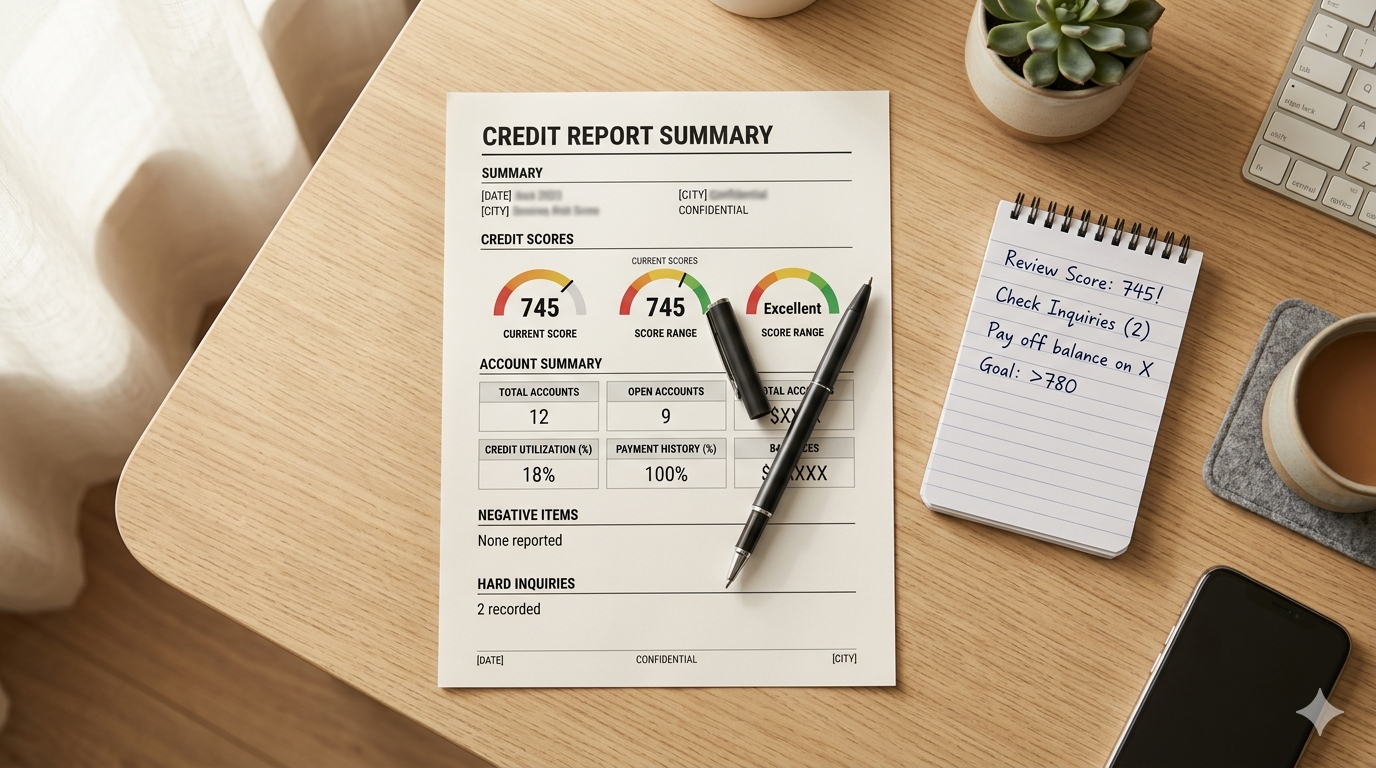
You Can Get Your Full Credit Report for Free — Right Now
Once a year, you are entitled to pull your credit report from all three major credit reporting agencies — Equifax, Experian, and TransUnion — at no cost. Go to AnnualCreditReport.com to access them.
Pull all three. Do not just check one and call it done.
Each agency may have slightly different information on file, and errors do happen. An account you closed years ago that is still showing as open. A debt that was paid but not marked as resolved. Even an account you do not recognize at all — which can be a sign of identity theft.
When you pull your report, look for:
— Accounts you do not recognize — Debts marked as unpaid that you know you handled — Old collections that are still affecting your score — Your overall credit utilization — how much of your available credit you are currently using
That last one matters more than people realize. Most lenders want to see that number below 30 percent. And here is something that surprises a lot of people: some lenders look at that 30 percent threshold per card individually, not just across all your cards combined. It varies by institution. If you are planning to apply for a mortgage or a major loan, it is worth asking your lender exactly how they calculate it before you assume you are in good shape.
Why Ignoring Old Debts Is Not the Same as Making Them Go Away
I do pro bono financial counseling alongside my regular practice, and one of the most common things I hear when we get to the credit report conversation is some version of, "Those are really old — I'm just not paying them."
I get the impulse. If something feels ancient, it can feel irrelevant.
But it is not irrelevant. Old unpaid debts can still impact your score, and your score can still impact your ability to rent an apartment, get hired, or qualify for insurance at a reasonable rate. The debt does not disappear just because you are done thinking about it.
If you are in that situation, the most important thing you can do is get an accurate picture of what is actually on your report. Some older debts may have already aged off. Others may still be there. Knowing the reality gives you the ability to make a real plan — and a plan, even a slow one, beats avoidance every time.

Credit Card Interest Is a 25% Problem Right Now
Let's talk about what is happening with credit card debt right now, because it is serious.
Interest rates on credit cards are running around 25 percent. That means if you are carrying a balance month to month, a quarter of everything you owe is growing — quietly, consistently — just in interest.
I have seen clients build up significant credit card debt with the intention of paying it off when a bonus arrives. The bonus comes. They spend it. The debt remains. In one case, a client ended up with $80,000 in credit card debt — and then got laid off. That is a situation that takes years to work out from under, and it did not happen all at once. It happened slowly, one swipe at a time.
If you are carrying high-interest credit card debt, here is the approach I recommend:
Step 1: List every debt you have and the interest rate next to each one.
Step 2: Pay the minimum on everything except the one with the highest interest rate.
Step 3: Put every extra dollar you can find toward that highest-rate debt until it is gone.
Step 4: Move to the next one and repeat.
This is sometimes called the avalanche method, and mathematically, it is the fastest way to get out of debt when high interest rates are the problem.
The Home Equity Trap Worth Knowing About
Here is something I see come up regularly: someone gets serious about their credit card debt, takes out a home equity loan to pay everything off in one shot, and feels like the problem is solved.
Except they do not cancel the credit cards.
Within a year or two, the cards are maxed out again — and now there is also a home equity loan to pay back. The total debt is higher than when they started, and now it is tied to their house.
If you use a home equity loan or any consolidation strategy to pay off credit card debt, the credit cards have to go with it. That part is not optional. The loan only works if you close the habit that created the debt in the first place.
A Word About Credit Counseling Services
You may have seen advertisements for credit counseling or debt management programs. Some of them are legitimate and genuinely helpful — they can negotiate lower interest rates on your behalf and create a structured payoff plan.
But some come with fees that are steep enough to put you in a worse position than you started, especially if you miss a payment or fall off the plan.
If you are considering a credit counseling service, ask upfront: What are all the fees? What happens if I miss a payment? Are you a nonprofit? Read the fine print before you sign anything. And be cautious of any service that promises dramatic results fast — real debt payoff takes time, and anyone telling you otherwise is worth a second look.
The One Thing to Do This Week
If you have not pulled your credit report recently, that is your one action item. Go to AnnualCreditReport.com, pull all three reports, and spend 20 minutes looking through them.
You are not looking for perfection. You are looking for clarity. Are there errors? Surprises? Old accounts dragging down your score that you did not know were still there?
Whatever you find, knowing is better than not knowing. Because you cannot make a good plan for your financial future based on information you are avoiding.

Ready to Get a Clear Picture of Where You Stand?
If you are a professional woman thinking seriously about retirement, understanding your credit score is just one piece of the foundation you need in place before the bigger planning can begin.
My free ebook — Build Your Future Blueprint — walks you through the foundational steps to get your finances organized and your goals clearly defined.
Or if you would like to sit down and talk through your specific situation, I offer a complimentary 30-minute get acquainted call. Come as you are — wherever you are starting from.
You have worked too hard to let a number you have never looked up quietly cost you money. Let's get the full picture — and go from there.
Joann North, CFP, is the founder of JNorth Financial LLC. She has worked in financial services for over 30 years, helping professional women build clear, personalized plans for their financial futures.